It’s time to finally dispel a common myth. Ohio State did not go on its magical run in last year’s College Football Playoff because the offensive coaching staff finally decided to call the “good plays.”
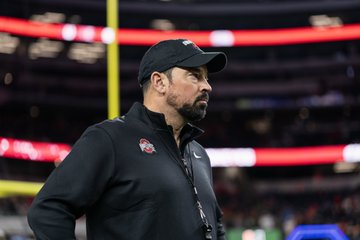
From the perspective of some Buckeye fans, the success of Ohio State’s offense over the last two years is almost purely predicated on whether or not head coach Ryan Day decides to open up the offense.
The story that has been told by many about the 2024 Ohio State team is as follows. The Buckeyes were a great team during the regular season that never quite reached their potential, in part, because Ryan Day and offensive coordinator Chip Kelly waited until the playoffs to truly unleash the offense by throwing caution to the wind with aggressive play-calling.
During this year’s regular season, the rhetoric from some in the media was that while Ohio State was fairly efficient, it was waiting until postseason play to show what it was truly capable of offensively. But in the postseason this year, Ohio State didn’t improve. In fact, the Buckeyes were much worse offensively than they had been since Week 1. In the Big Ten championship, the Buckeyes put just 10 points on the board in a three-point loss to Indiana, and then in the Cotton Bowl, they only scored 14 points, while committing a couple of crucial turnovers in a 10-point loss to Miami.
The common denominator in not just these losses, but the other poor offensive performances Ohio State has had over the last two years is not bad play-calling, but bad matchups.
Dating back to last year, the games in which Ohio State’s offense has struggled the most are the ones where the opposing team has an elite defensive line. The Buckeyes notoriously struggled against Michigan last year, in large part, because the Wolverines could contain Ohio State’s elite passing attack by dropping several players into coverage, and still be OK against the run because their defensive line was so much better than Ohio State’s offensive line.
Several defenses have followed that blueprint and have had sustained success. One team that followed that blueprint to a tee was Texas. During the College Football Playoff semifinals last season, weeks after Ohio State supposedly opened up the offense, the Longhorns seemingly bracketed Ohio State star receiver Jeremiah Smith with two or three defenders all game, and were able to do that because their defensive line didn’t need much help in the run game.
Ohio State scored 28 points in that game against Texas, but really sustained only two touchdown drives during that game, as one touchdown came on Jack Sawyer’s scoop-and-score and another came on a long catch-and-run right before halftime by TreVeyon Henderson.
I’m not trying to invalidate the Buckeyes’ run last year by any means. Ohio State made those plays and deserved to win that game, but it isn’t true that the Buckeyes cured all of their offensive issues last year by simply calling better plays.
This year, the Buckeyes had the same issues against defenses with great lines. The Buckeyes scored enough to pick up the Week 1 win over Texas, but still only scored 14 points and totaled just over 200 yards.
Ohio State had much more offensive success against Michigan than it had last year against its rival. However, without star interior defensive linemen like Mason Graham and Kenneth Grant, the Wolverines’ 2025 defensive line was a far cry from what it was last year.
It wasn’t until the Big Ten championship that the Buckeyes faced a truly elite defensive line and, once again, they failed to establish a run game and subsequently struggled to put points on the board.
It was the exact same story in the Cotton Bowl. The Buckeyes hit some explosive plays in the quarterfinals of the College Football Playoff, but against Miami’s ultra-talented defensive line, they were no match.
Throughout this season, many have believed Ohio State’s continued reliance on the run game, despite the strength of the offense being at the wide receiver position, was a product of the coaching staff wanting to slow games down and keep the players fresh heading into the postseason. I think there’s some truth to that, but I also think Day wanted the Buckeyes to run the ball because he knew they’d have to improve on that front to make another postseason run.
It’s easy to say Ohio State should just lob the ball up to Smith and fellow star receiver Carnell Tate and go from there, but more often than not, the more physical team wins in football. The Buckeyes saw what happened against Miami when they didn’t establish the run game. On several occasions, they were backed up in third-and-long situations, where they had to throw the ball. On those third-and-long situations, Miami’s star pass rushers Rueben Bain Jr. and Akheem Mesidor could simply pin their ears back and go to work on a Buckeye offensive line that wasn’t as good in pass protection as many, including myself, previously thought.
Perhaps no sequence better exemplified Ohio State’s offensive problems than the one that ended in a pick-six for Miami.
On the first play of Ohio State’s first second-quarter drive, the Buckeyes took a shot to Smith, who broke free on a post route to haul in a 59-yard pass from Sayin, but then on the very next play, Sayin was sacked by Bain. Backed up way behind the sticks on second down, Ohio State went with a screen pass, likely because they didn’t trust their running game, and after Smith missed a block, Miami defensive back Keionte Scott intercepted Sayin’s pass and went 72 yards for a pivotal touchdown.
It’s easy to blame play-calling for Ohio State’s offensive issues, but until the Buckeyes can rely on their offensive line, they will continue to struggle against defenses with talented fronts.