Sam’s Stance: Ohio State Should Keep Options Open At Slot Receiver
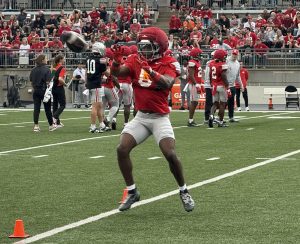
Ohio State’s receiver corps has consistently produced elite talent, but as head coach Ryan Day and new offensive coordinator Arthur Smith continue shaping the Buckeyes’ 2026 offense, evaluating alternative options at slot receiver could help elevate the unit’s overall ceiling.
While Ohio State’s starting slot receiver in 2025, senior captain Brandon Inniss, has proven to be a reliable pass catcher and respected leader, he has yet to fully match the expectations that came with his five-star recruiting ranking in the class of 2023, which he earned out of American Heritage in Fort Lauderdale, Fla.
Inniss has been passable for Ohio State over his first three campaigns with the Buckeyes, but hasn’t been much of a difference-maker alongside top talent like Emeka Egbuka, Carnell Tate and returning two-time Big Ten Receiver of the Year Jeremiah Smith.
As Ohio State’s fourth wideout in 2024, he caught just 14 passes for 176 yards and one touchdown in 2024, before upping those figures to 36 receptions for 271 yards and three scores as the Buckeyes’ wide receiver No. 3 in 2025.
While those junior-year numbers are respectable, they don’t exactly jump off the stat sheet. A fair portion of that limited production can certainly be attributed to competing for targets alongside former and future first-round draft picks. However, the reality remains that Inniss has largely been a safety valve rather than a primary weapon in the Ohio State offense. He hasn’t mirrored the explosive, high-volume production of recent Buckeye slot receivers like Egbuka in 2024 or Jaxon Smith-Njigba during his historic 2021 campaign.
To fully unlock this passing game, Day and Smith should move away from relying on a single slot receiver and instead implement a rotation, especially with the Buckeyes boasting one of their deepest receiving corps in recent memory.
With Inniss’ reliability as a pass catcher to move the chains and the explosive nature of transfers Kyle Parker of LSU and Devin McCuin of UTSA, Ohio State has the personnel to create a far more dynamic rotation in the slot.
Mixing different skill sets could force defenses to adjust on a weekly basis while also giving the Buckeyes more versatility in how they attack opposing secondaries.
The experienced senior McCuin compiled 152 receptions for 1,696 yards and 16 touchdowns over three seasons at UTSA, highlighted by a 65-catch, 726-yard, eight-touchdown performance in 2025. At 6-0, 189 pounds, he profiles as a dynamic weapon who can turn routine touches into explosive gains and also stretch the field vertically as a legitimate deep threat.
On the other hand, the 5-10, 195-pound Parker offers a more compact build, shifty after-the-catch ability, and polished route-running that makes him a lethal option underneath routes. He arrives in Columbus with 34 receptions for 385 yards and five touchdowns across two seasons in the SEC at LSU.
Parker’s quickness and route-running can steady Ohio State’s short-to-intermediate passing game, while McCuin’s elusiveness adds a big-play threat that can change field position instantly.
Inniss did a fine job last season inside the slot by himself, though solid football isn’t quite the standard of Ohio State, especially at the receiver position. In a program built on elite receiver play, the slot must consistently generate explosive production while also serving as a dependable outlet for the quarterback. While Inniss has provided stability and reliability, Ohio State typically demands more game-changing production from that role.
Rotating both transfers with the captain would give Arthur Smith multiple answers based on defensive coverages. With a rotation also heavily expected at the outside receiver position opposite Jeremiah Smith, it makes perfect sense for the Buckeyes to lean into interchangeable, versatile roles across the entire passing game.