Sam’s Stance: Late Season Loss Will Prove Beneficial For Ohio State, But It Can’t Become A Trend For Buckeyes
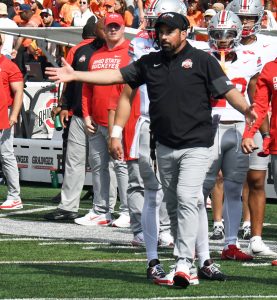
For the second season in a row, Ohio State has faltered, 13-10, in arguably its biggest late season matchup of the year and its opponent once again exposed multiple Buckeye shortcomings.
Last season, a lackluster 6-5 Michigan team went into Ohio Stadium and upset then-No.2 Ohio State before the Buckeyes torched a playoff gauntlet of No. 9 Tennessee, No. 1 Oregon, No. 5 Texas and No. 7 Notre Dame by a combined 70 points.
This go around, Ryan Day’s No. 1 Buckeyes managed to defeat the Wolverines for the first time since 2019, but suffered a tough loss to No. 2 Indiana in the Big Ten championship on Nov. 6.
Although it’s not quite as heartbreaking as last year’s loss to Michigan and likely won’t lead to the entire team meeting to discuss the state of the program, but as mentioned, it still revealed multiple deficiencies, similar to the game against the Wolverines in 2024.
Most notably, protection issues in both Ohio State’s pass and rush attacks were highlighted by Indiana’s elite front seven. Julian Sayin was sacked five times in the Buckeyes’ loss to the Hoosiers, three more times than any team had on Ohio State in a single game all season. Heading into the conference title game, the Buckeyes had allowed just six sacks through 12 regular season contests.
Indiana got in the backfield a total of nine times for tackles for loss, but according to Day, captain and left tackle Austin Siereveld and left guard Luke Montgomery, Ohio State was simply a few connected blocks away from eliminating those negative offensive plays or breaking off for chunk plays. But at the end of the day, that’s football.
Like Day has repeatedly emphasized and even said on Sunday after the loss, if the team leaves the game up to a single play, you are leaving doubt. So if you don’t put yourself in a disadvantageous position with mistakes throughout the game, you won’t be in that spot in the first place, which Ohio State didn’t do against the Hoosiers.
Additionally, Ohio State had struggled with its red zone offense all season, but Indiana further exposed the weakness in Indianapolis. The Buckeyes reached the red zone four times and came away with just 10 points. Ohio State’s mishaps included a failed quarterback sneak on fourth-and-1 by Sayin in the third quarter, and a fourth quarter drive when Ohio State was down three points that stalled at the Hoosiers’ 9-yard line before senior kicker Jayden Fielding missed a 27-yard field goal wide left.
It was also identifiable that Ohio State’s play calling and on-field issues in big moments and in situational football weren’t up to snuff. For me, the kicker was the repeated emphasis on using jumbo 13 and 14 personnel on third downs, as Indiana routinely snuffed out the heavy set package that typically has limited receiving options. This was also the personnel Ohio State used on Sayin’s missed throw to tight end Bennett Christian just before Fielding missed the game-tying kick.
With that being said, there were still flashes that suggest this loss could fuel something far greater, similar to 2024. Sayin threw for 258 yards, freshman running back Bo Jackson averaged 4.9 yards per carry and star wideout Jeremiah Smith continued to look like the most dangerous receiver in the country with 144 yards on eight catches. On the other side of the ball, defensive end Caden Curry, linebacker Sonny Styles and safety Caleb Downs seemed to be everywhere, helping hold Indiana to just 13 points with a scoreless fourth quarter. That’s not to mention the defense still has yet to give up more than 16 points in a single game.
If last year’s script is any indication, Ohio State is once again positioned to use a late stumble as motivation rather than a derailment. In 2024, the Buckeyes responded with a renewed edge and confidence that carried them to a national championship.
And given what we’ve seen at Ohio State’s peaks this year, there is no reason to believe this season’s Buckeyes cannot do the same. The pieces are in place. Ohio State’s roster top to bottom is arguably the most talented in the country and the loss to Indiana has now shown what needs to be corrected. All Ohio State must do now is take it game by game and execute.
However, while a late-season loss may once again serve as a catalyst for the Buckeyes, it cannot become the norm for Day and the program. Ohio State should not need to lose in order to wake up and fix its issues. Championship teams build consistency long before December, not as a reaction to a defeat.
Sooner or later, a late-season stumble will cost Ohio State, especially if that “wake-up call” comes in the first round of the College Football Playoff instead of the Big Ten title game. But until then, Ohio State must focus on what lies ahead – the potential for back-to-back College Football Playoff championships. The Buckeyes will have to wait until next year for a potential perfect run from Michigan to the postseason,
Ohio State is fortunate it will again hold the chance to capture another national title, but the Buckeyes cannot allow late season losses to become a constant every season.